Saturday, September 05, 2009

IN HONOUR OF GANI FAWEHINMI (1938-2009)


Gani Fawehinmi (1938-2009) is the most famous figure in Nigerian history who made a name using his legal training and resources in fighting for justice for the Nigerian people.The only other legal figure who could be said to have his prominence as a lawyer is Rotimi Williams ((1920-2005), but "Timi the Law",even though he demonstrated the courage of an independent minded person along with his legal brilliance,was not a social activist like Gani was.

Gani was one of the ever resilient few,along with Nobel Laurete Wole Soyinka and other figures,who insisted on fighting causes whose primary or only relationship with their own well being was that it affected all Nigerians.He endured imprisonment,harassment and the climate of assassination created by the Babanginda and Abacha regimes in battling causes which,even though,they did not always succeed against totalitarian governments who controlled the organs of the law,succeeded in focusing national and international attention on the villainy represented by a significant number of the activities of such governments,as well as highlighting their illegitimate means of coming to power.Particularly memorable for me is his long,dogged and unsuccessful attempt to prosecute two military officers,Halilu Akilu and Tunde Togun,on cirumstantial evidence,for complicity in the 1986 assassination of the journalist Dele Giwa,during the Babangida regime,a murder unsolved till today and for which,as far as I know, no prosecution has been carried out.

His death this morning,5th September 2009, suggests the beginning of the end of an era of a particular generation of public activists in Nigeria,following on the death in 2006, of Beko Ransome Kuti(1940-2006), who,along with Fela Anikulapo (1938-1997) and Olikoye (1927-2003),to adapt the words of former President Olusegun Obasanjo,were,along with their sister,Dolupo,their mother,Funmilayo Ransome Kuti ( 1900 – 1978)and father Israel Oludotun Ransome-Kuti (1891 to 1955) members of "the legendary Ransome Kuti [family] of Abeokuta".

Younger and older members of the group who fought such death defying battles are still with us,such as Femi Falana and Wole Soyinka,but I wonder whether the culture of civic resistance these people represent is still as powerful as what they demonstrated.The fact that Nigeria has had a democratic government for some years,with relatively orderly succession at the highest level in one election,means that the inspiration and the character of such resistance might be changing.Perhaps the struggle is becoming less spectacular,more focused on the effort to speak truth to power,to mobilise the resources of the press and the Internet in presenting and mobilising support for alternative perspectives to those of the government.

The culture of civic activism Gani represents is marked by being embodied by members of a highly educated and cosmopolitan elite,most,in my understanding ,being from Southern Nigeria,and a few from the North.

Do people like those,whose vision and career are visibly centred in self and tribally transcending values,have a place in government?Should such people try to influence public policy and its execution through participation in the political process?Those who are better informed than myself can better judge the character and accomplishment of various Nigerian politicians and of technocrats in the Nigerian government..In doing that,the brief career of Wole Soyinka in the Babangida government and of Gani's efforts at the centre of a political party would be examined as to the challenges facing Nigerian visionaries in politics.Soyinka's role was different from that of Gani,Soyinka being appointed by Babangida,as Olikoye Ransome Kuti was in the health ministry,to oversee particular initiatives under the auspices of the government.Gani's aspiration was different.His political amibitions were not centred in the idea of :simply working within a government but he sought to be central to the formation of a government.I do not know how seriously he pursued that vision.His lifetime of activity as a gadfly of the state in the Socratic sense,however,will remain legendary in Nigerian history.

Wednesday, August 19, 2009

TOMORROW IS HERE: GOOGLE ESTABLISHES MOON COMPLEX,BEGINS RECRUITMENT FOR LUNAR WORKERS,PROMISES DRAMATIC CHANGES IN SEARCH CAPACITY FROM ADVANTAGES OF

Google Copernicus Center is hiring

Google is interviewing candidates for engineering positions at our lunar hosting and research center, opening late in the spring of 2007. This unique opportunity is available only to highly-qualified individuals who are willing to relocate for an extended period of time, are in top physical condition and are capable of surviving with limited access to such modern conveniences as soy low-fat lattes, The Sopranos and a steady supply of oxygen.

The Google Copernicus Hosting Environment and Experiment in Search Engineering (G.C.H.E.E.S.E.) is a fully integrated research, development and technology facility at which Google will be conducting experiments in entropized information filtering, high-density high-delivery hosting (HiDeHiDeHo) and de-oxygenated cubicle dwelling. This center will provide a unique platform from which Google will leapfrog current terrestrial-based technologies and bring information access to new heights of utility.


A brave new frontier in search science.


Why a lunar location?

It's a logical question to ask. Google's current engineering facilities in the United States, India and Switzerland are all leaders in search technology development. However, by locating a research and technology center on the Moon, Google engineers will be able to experiment with an entirely different set of parameters. For example, imagine tapping unlimited solar energy to drive megawatt data centers and power innumerable arrays of massively parallel lava lamps, with ample no-cost cooling available to regulate the temperature of server farms sprawling over acres of land unblighted by sentient lifeforms or restrictive zoning ordinances.

Moreover, Google's Copernicus Center will provide a clear ear on the chatter of the universe, the vast web of electromagnetic pulses that may contain signals from intelligent life forms in other galaxies, as well as a complete record of every radio or television signal broadcast from our own planet. Google's goal is to extract information from that cacophonous web and make it available to anyone with a mouse and a modem. Imagine discovering not only alien attempts at communication with Earth, but also such heretofore unavailable cultural treasures as Pink Floyd's 1968 appearance on the BBC and the tragically lost first season of "Iron Chef."

With the establishment of the Copernicus Center, Google's mission has grown beyond "organizing the world's information and making it universally accessible and useful." Our new goal is to "organize all the useful information in the universe and serve it to you on a lightly salted cracker."

What are the challenges?

The first non-trivial challenge is building a lunar base. Google began drawing up plans for the construction of a lunar facility in the Copernicus Crater early in 1998, when the company's founders Larry Page and Sergey Brin were still graduate students at Stanford University. Applying a Patel extrapolation to Rosing linear projections, Page and Brin predicted that every man, woman and child on earth would be conducting at least seven searches a day by the year 2018. While their projections correctly predicted random spikes in search traffic due to wardrobe malfunctions, they failed to adequately factor in the hyperbolic trajectory of Britney Spears, which accelerated the rate of global search growth by a factor of seven.

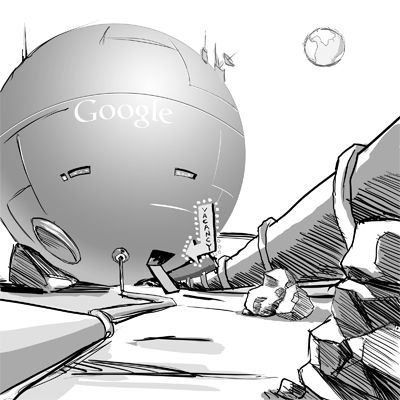
Google's initial base, a spherical structure containing living quarters and a small data center, will take two and a half years to construct. This first G.C.H.E.E.S.E ball has been christened "the Googlunaplex" and will be populated by a dedicated cadre of software engineers, hardware operations technicians, cable installers, quantum mechanics and space planners. Google is firmly committed to using only earth-originated staffers and no jobs will be outsourced to lunar residents or those from other planetary systems unless the skill sets they offer cannot be easily replicated by native born terrestrials.

The Googlunaplex will house 35 engineers, 27,000 low cost web servers, 2 massage therapists and a sushi chef formerly employed by the pop group Hanson.

Searching the heavens

Once the facility is built, the real work begins. Google will be exploring a number of exciting research projects that have the potential to advance search science to a new frontier. Among the questions Googlunars will seek to answer are:

  • Exactly how far does the Worldwide web extend? Can it become an interplanetary utility? If so, will it replace Water Works on Monopoly®?
  • What are the likely effects of link attenuation over extreme distances? Is there a limit to link strength, or is it infinitely extensible like bubble gum that gets stuck to the bottom of your shoe?
  • What happens to PageRank in the proximity of a black hole? Is there distortion that might result in link relevancy reduction or popularity warping? Could this somehow be harnessed to generate more dates for engineers?
  • Does spam go on forever?

New rules. New tools

The rules of coding will literally be stood on their head at the Copernicus Center, as the absence of gravity plays havoc with the normal ordering of data. Search results lacking in substance may rise to positions of prominence while those possessed of a desirable gravitas may become negatively buoyant. Simple computing exercises, such as building a list inverter become problematic when "up" or "down" are not clearly defined, and subroutines are disrupted when values increment six times faster than in Earth gravity.

Obviously, a new set of tools for computing in the unforgiving conditions of deep space is needed. This month, Google will release version 10.0 of an operating system that has been optimized for the demands of extra-terrestrial computation. Known as "Luna/X," the new command architecture is impervious to radiation, low gravity, absolute zero temperatures and airless environments. Even the most intricate scripts coded in Luna/X can withstand the harsh conditions of lunar operation for months, if not years.

Luna/X will be made available to terrestrial developers free of charge and a testing environment will be constructed to replicate the conditions under which the code will likely be deployed. Through a partnership with an as yet unnamed hamburger chain, Luna/X engineers will be able to simulate a lunar work environment by ingesting tasteless freeze-dried nutritional byproducts while coding in noisy, crowded quarters suitably lacking any trace of atmosphere.

Space is no place for normal code. Luna/X runs with 99% reliability at near absolute zero temperatures

Life in the Googlunaplex

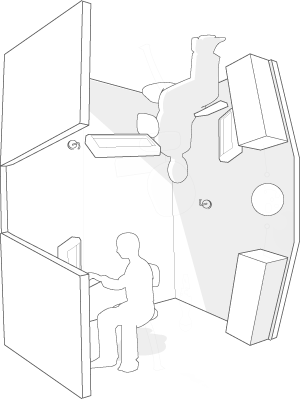
The Googlunaplex is a working environment that will be unique both because of its location and its design. Based on a working model constructed by Google co-founder Larry Page from Lego® Mindstorms™, the facility features compact living quarters and a state of the art server farm that are co-mingled to maintain a delicate bio-technical balance. In traditional Google style, space will be used with extreme efficiency, with Googlunars sharing quarters with machines that generate search results as well as enough heat to warm the entire Googlunaplex and several hot tubs.

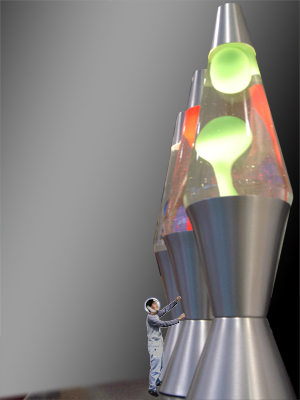
Naturally, Google's earth-based culture will be replicated as closely as possible. An extreme sushi chef will harvest kelp and aquatic life from giant lava lamp oxygenators and the living space will be filled with colorful rubber balls (because of space constraints, they will be sub-atomic in size). There will be a steady supply of snacks and ample caffeine replenishment through a partnership with Starbucks, which will be opening a store less than a kilometer away in early 2006. Leagues for reduced gravity roller hockey games are already forming and massage therapists are undergoing special training on how to induce stress to counter the effects of a low-gravity lifestyle.


Giant lava lamps filled with biomass suspended in seawater generate oxygen for the complex


Thrust yourself to the forefront of search

If you're intrigued by the opportunity to launch a new career, now is the time to step forward. For more information about the Google Copernicus Hosting Environment and Experiment in Search Engineering, please contact us today at lunarjobs@google.com.

Applicants must be at least 18 years of age by April 1, 2007 and have proof of earth residency. Google is an equal opportunity employer.

.

Thursday, October 12, 2006

Correlate the idea of threshold concepts with Aquinas's conception of mysticism as described in Catholic Encyclopedia and with Maurice Bucke's conception of mysticism in relation to cognitive psychology in Cosmic Consciousness.

What relationship could these ideas have to Hirst's ideas in Knowledge and the Curriculum and to Platonic conceptions of teaching in the Republic as well as to education as Initiation by RS Peters?

Tuesday, October 10, 2006

Threshold Concepts

Threshold concepts are a relatively new idea developed by Meyer and Land (2003) and applied to economics by Davies, P. (2003) and Reimann and Jackson (2003). They offer a potential way of describing levels of understanding in a subject that could be used in assessment for learning.

Meyer and Land define threshold concepts as having five characteristics.
· First, they should be transformative, in that once acquired they should shift perception of the subject.
· Second, they should be irreversible. Once an individual has begun to perceive the world in terms of a threshold concept it should be inconceivable that they would return to viewing it in a more primitive way.
· Third, a threshold concept is integrative. Meyer and Land describe this as the capacity of a concept to expose the previously hidden interrelatedness of something.
· Fourth a threshold concept is bounded. That is, it helps to define the boundaries of a subject area.
· Fifth, a threshold concept may be counter-intuitive, or lead to knowledge that is inherently counter-intuitive. In grasping a threshold concept a student moves from common sense understanding to an understanding which may conflict with perceptions that have previously seemed self-evidently true.
A number of possible threshold concepts have been suggested for economics: opportunity cost, elasticity and economic systems as ‘non-zero-sum games’.

If this analysis is correct then there are important implications for assessment and learning.
· First, assessment of a subject should focus on finding out whether students have really grasped these threshold concepts since they are the binding ideas that together represent the ability to think in the way expected of an expert in the subject. It will be especially important not to create assessment formats in which students can appear to have understood the subject when they only have a very partial understanding. Since the idea binds understanding of a subject, failure to understand the concept will prevent the learner from having access to the real meaning of content that is taught later in the course.
· Second, the threshold concept should not be introduced before students have acquired knowledge of a range of contexts in which the concept may be used. That is, if the concept is introduced early in the course the student can only learn it in a partial sense because they cannot integrate it with a wider understanding.


From Davies P and Brant J (forthcoming) Teaching School Subjects: Business and Enterprise, London: Routledge
On threshold concepts

Introduction


Conference description

Conference flyer


Seminal Papers

1. Meyer and Land, 2003

2.Land,et al, 2004

3. Land,2006

4.Meyer,2006


Applications

1. Overview


2.Technological aids


3. Economics


1.1. A.ETC project site and Higher Education Academy description of ETC project and description of project at Economics Network


a.ETC project articles portal


b. Theoritical reasoning


c.Problem Focused Learning


1.2.Case study


1.3. Critique of thresholds concept idea


4.Information Systems


5.Computer Science


6.Health Care

7.Environmental Change

7.Rangeland Management